


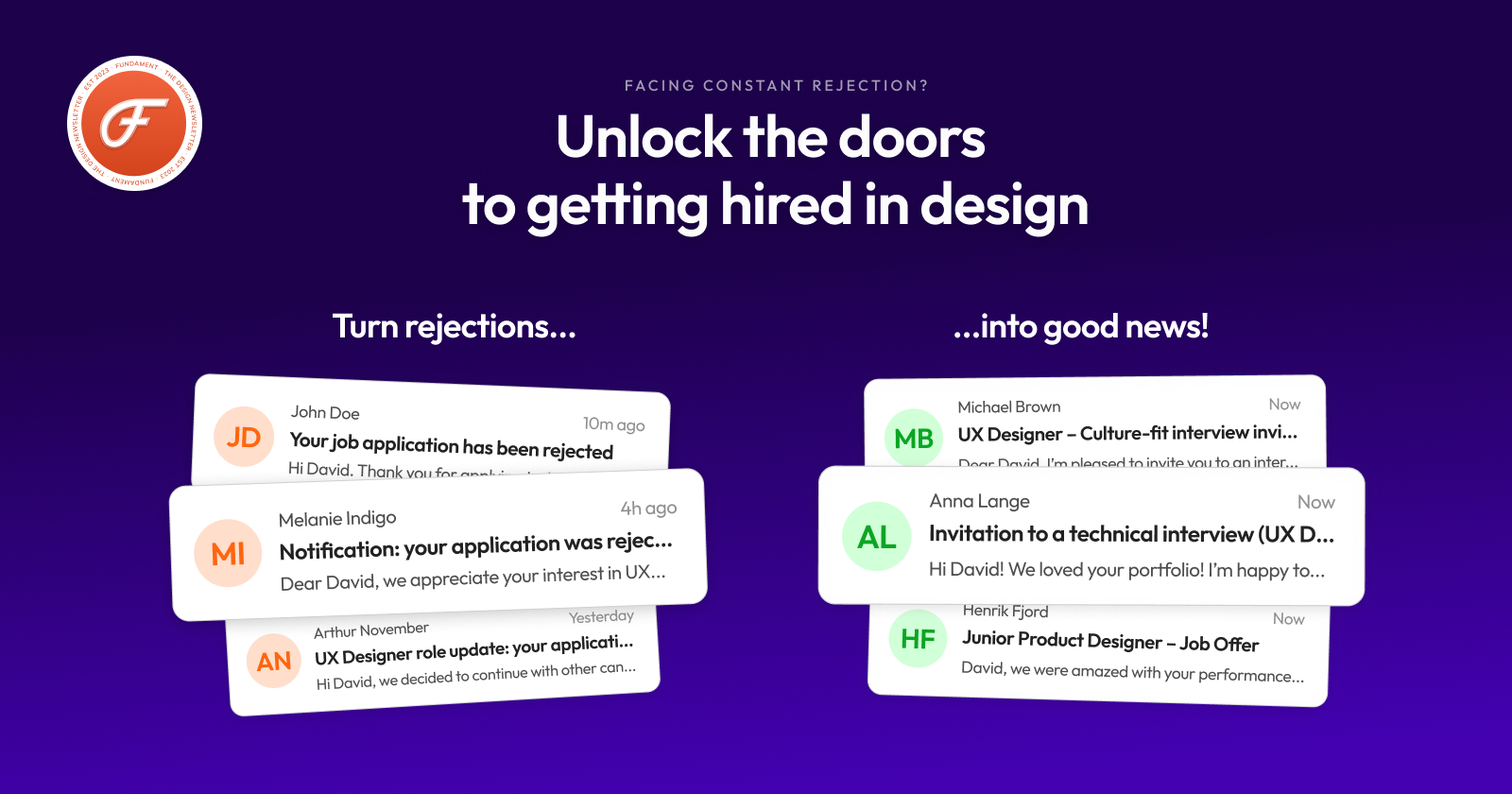
The usual recruitment process never has a single stage. In almost every case, you can expect a multi-stage process consisting of an interview with HR (the so-called company culture-fit interview), a technical interview (the one where you actually discuss design with a design leader), an assignment, and sometimes an interview with the product team and/or a director or VP of the department. The last one is expected for senior roles, but it might also happen for entry-level roles in smaller organizations.
Can you prepare for each stage of the process? Definitely! We gathered 15* questions you may hear during a technical interview with a design leader and included a few ideas on how to respond. Get prepared well!
Portfolio Done Right
This article is one of the chapters from Portfolio Done Right, our latest ebook that helps you build an outstanding portfolio and resume and write compelling cover letters. The ebook is available for purchase for just $13. We offer the ebook for free to our paid subscribers.
1. Why do you want to work for our company?
To give a satisfying answer to such a question, some research about the company you are talking about is needed first. I can't imagine working for a firm whose values don't resonate with my worldview. Different factors will drive different people, and every company will attract talent with different things. Some companies can do this with multiple attractors.
Let's take a company like the NBA as an example. As a designer, you may want to join the NBA to work on their website, which is used by millions of users who are following their favorite teams, watching the games, and checking the scores. As a basketball fan and a designer, you may want to join the NBA–the greatest basketball league in the world–to be close to the competition and, in addition, enhance the user experience for other sports fans like you. If you are not a sports fan or working on a product millions of people use doesn't excite you, you may still want to join the NBA as a designer. NBA is innovative, inclusive, highly ethical, and develops numerous internal projects. If these values resonate with you, that could be your why.
Simon Sinek explained why joining a company whose values resonate with yours is super important in The Infinite Game.
2. What's your biggest failure?
When answering such questions, it's important to be honest, show self-awareness, and demonstrate how you've grown from the lesson learned. Talk about a failure related to UX designer's skills, but don't shoot yourself in the foot by speaking about one of the crucial skills that may lead to an interviewer doubting your abilities. Explain the project and put your failure into a wider context. Take responsibility for the failure and avoid blaming others. And now, what's most important is to debate what you've learned from your mistake and how this failure pushed your growth.
3. What would an ideal design process look like?
Recruiters and senior designers understand well that an ideal design process is usually far different from the real one. Let's say you can put the time and budget constraints aside and think of this mythical ideal design process. What does it look like?
You must remember one crucial feature of every design process: it's never linear. It's not a list of steps you tick off one after another. So, the best answer would be a process that allows us to do as much user research as required, incorporates business needs, and isn't blocked by technology limitations. A process that empowers the whole product team and allows them to succeed together.
4. What is the most important skill of a UX designer?
Since UX designers should be equipped with a variety of skills, naming the single most important one would be very subjective. To safely dodge this question, you could discuss a few from the following list:
Empathy - designers are great at wearing users' shoes to understand their pain points and needs better.
Solving complex problems - designers can take a look at problems from different perspectives and propose elegant solutions to simplify things.
Prototyping and visual design - designers need to be able to translate their ideas into usable artifacts.
Business acumen - to understand the business context of the product.
User research - as designers produce their solutions ultimately for the users.
Collaboration and communication – to balance the needs of business, users, and technology.
5. How would you defend your design rationale?
The best way to defend your design decisions in every conversation, even with the toughest, truly opinionated, and most stubborn stakeholders, is to bring data to the table.
They can't fight data.
Whenever you expect a tough design review session, do at least desk research and guerilla usability tests beforehand. Show the numbers that support your designs. It could be a report or a study you found online. It could be a study you've done yourself. But it shouldn't be only your expert opinion.
Get the FREE ebook
The additional ten questions (and how to answer them) can be found in our latest ebook, Portfolio Done Right, premiering Friday, 2 August. The ebook will be shared with all our subscribers for FREE throughout the entire August.
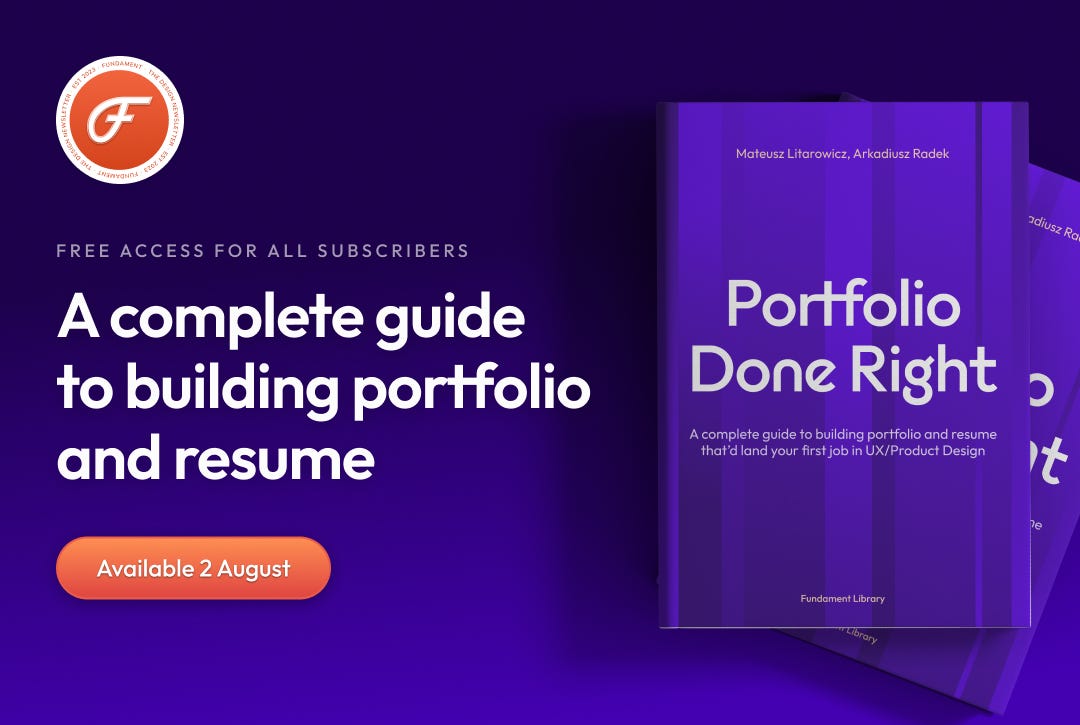
Portfolio Done Right is a 100-page guide that will help you with:
Building an outstanding portfolio that lands entry-level jobs
Structuring your case studies not to bore recruiters to death
Enhancing your resume so it’s shining yet simple
Writing compelling cover letters to grab the attention of recruiters
Getting prepared for job interviews and the entire recruitment process
Subscribe to Fundament to get the ebook for FREE throughout the entire August, beginning Friday, 2 August.
Image attribution
Cover photo from The New York Public Library.
Great article! — Thanks for sharing these questions.
I'd add getting familiar with the STAR method, which is frequently used for engineering interviews and might be beneficial every time you need to describe a specific challenge (Question 2 might benefit from it in your examples).
https://en.wikipedia.org/wiki/Situation,_task,_action,_result