


In the very first episode of Fundament, we try to answer these burning questions:
Is the Product Designer role just another evolution of the UI/UX Designer title?
What if UI/UX Designers reported to Engineering Managers?
Product-based vs. Project-based work – how is it different?
Ready? Let’s start!
Observing online discussions about User Experience, especially if you are new to the field, may raise many questions. Why do we have so many job titles, and how do we differentiate them? What does a Product Designer do in their job? What are the responsibilities of a UX Designer? And why do some say that calling yourself a UI/UX Designer is a passe nowadays? In this article, I will explain it so that it will become much more straightforward. Mainly if you are willing to join the UX industry and are still determining who you want to be.
But let's begin with a story. So, I was talking to my manager the other day. She was an Engineering Manager, but at the same time, she had a robust product mindset, so it wasn't strange to report to her as a Product Designer. We discussed our org tree in that we just witnessed a significant update. She decided to switch her focus entirely to the product, so the engineering team needed a new manager. The design team needed it as well.
The main point of the discussion was what we should do with the design team after this change. Should it report to this new Engineering Manager as it used to, or should it be closer to the product? Intuition says product, and you probably would pick this one too.
This whole discussion started a strange thought process, and this controversial take popped into my mind – a UI/UX Designer could be an engineering role. Have I lost my mind?
I will explain it shortly.
We should begin with a clear role definition. How to do it properly? Initially, we can define these roles by considering their expected deliverables. Let's kick things off with the responsibilities of a UX Designer. What would you expect from one?
UX Designer’s profile
A UX Designer is employed to make a digital tool easy to use. They do everything to ensure the team and the stakeholders that the product they work on is usable and accessible. Their work focuses on observing how users use it, learning their struggles, and developing solutions to improve it. In order to accomplish these tasks, they use different methods and produce various deliverables.
A job description of a typical UX Designer would most probably consist of the following duties:
Cooperate with the UX Researchers on planning and executing UX research activities such as surveys, in-depth interviews, and usability testing sessions. Sometimes, they would do the research independently when a UX Researcher role does not exist in the organization's structures.
Leverage analytical data to glimpse trends and weak points in the user flows.
Create user personas from the data from UX research to give the whole product team an understanding of their users.
Design user flows, wireframes, and prototypes to validate their ideas and guide the engineering team.
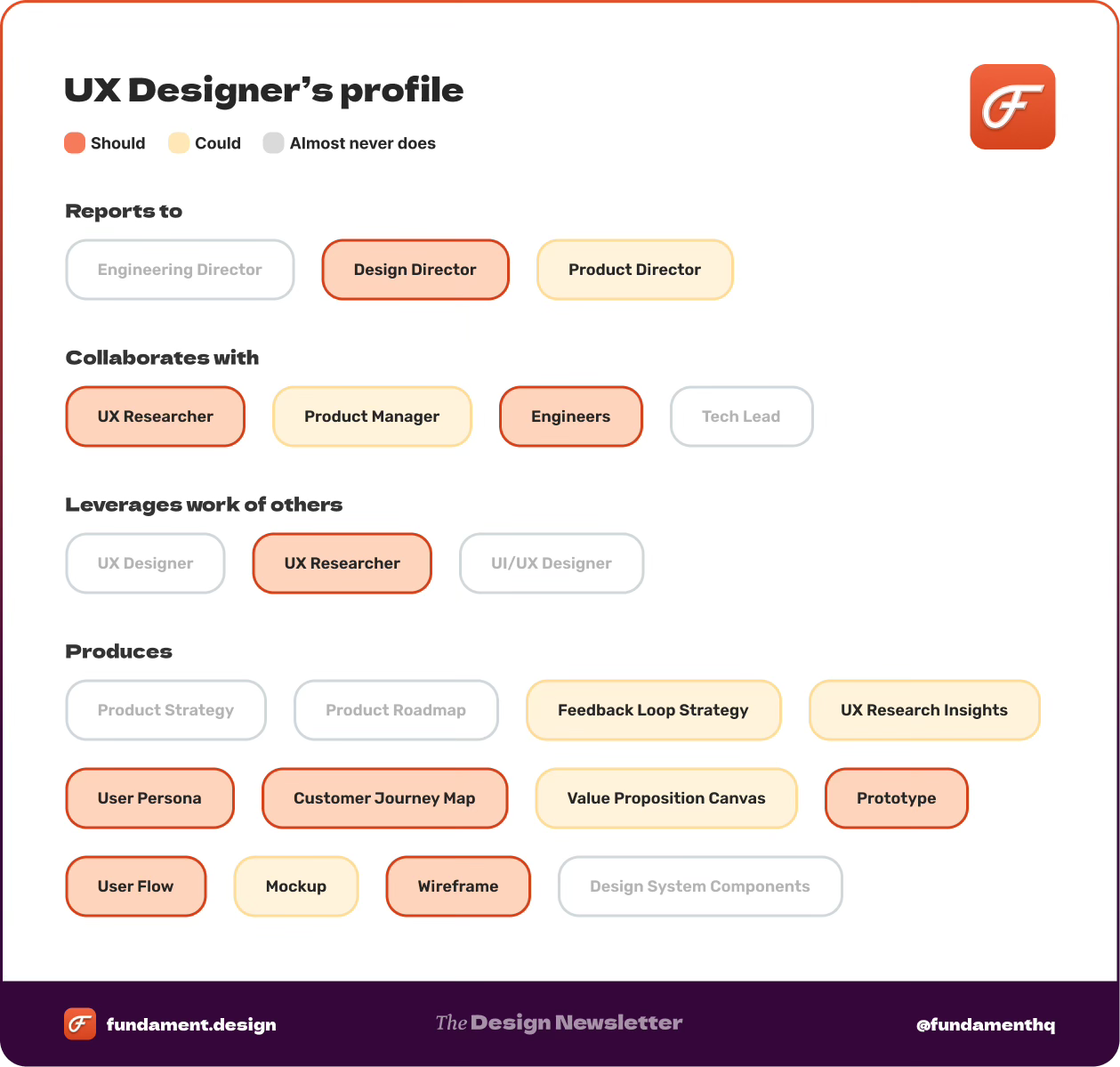
Please bear in mind that not all items mentioned here apply to every UX Designer job description. Depending on the organization, this list might be slightly different. Not all UX Designers touch the User Interface. Some only create black-and-white wireframes and leave it up to the UI/UX Designers to make it visually appealing. Others would do things I didn't mention, like conducting workshops with development teams and stakeholders.
UI/UX Designer’s profile
We are smoothly transitioning to the UI/UX Designers – what do you feel they do? Usually, they merely contribute to conducting user research and creating personas or customer journey maps. Their focus is instead set on the User Interface.
If I think of their expected deliverables and day-to-day duties, I'd list the following:
Design user flows and mockups to guide the engineering team based on insights from UX research prepared by other departments.
Prepare micro-interactions and animations within the user interface.
Develop internal design system or UI Kit components.
Write technical documentation of designed components.
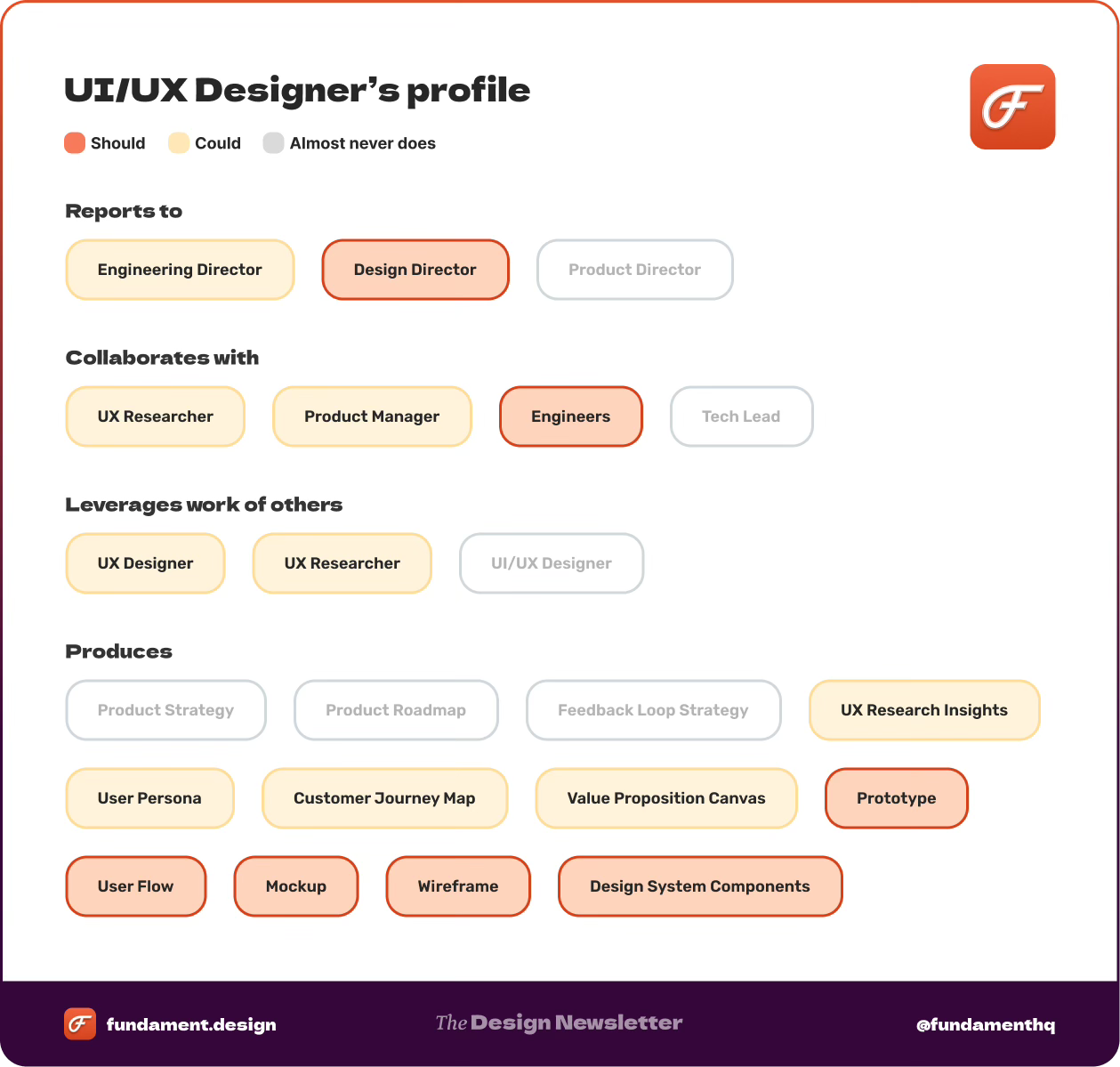
Research does not exist or is significantly limited, and the weapon of choice is Figma. They are in a constant loop with the Engineers but don't talk to the users as often as UX Designers and Researchers. Their deliverables are translated straight into code by Engineers, and they rarely validate their value for the users. That's why I wrote in the opening that this role could easily report to an Engineering Manager. Such a scenario makes sense if there's no other structure to manage the work of the Designers. Still, ideally, Designers would report to a Design Manager who understands the value that design can bring to the business and can adequately use their spot at the table.
Product Designer’s profile
And finally, let's look at the role of a Product Designer. They usually work in Product Trios, a setup proposed by Teresa Torres in her book Continuous Discovery Habits. Such a trio consisting of a Product Manager, a Technical Lead, and a Product Designer is a cross-functional combination of people with different perspectives and duties working together on the vision and shape of a digital product. What does a typical Product Designer do in their daily job?
I'd put the following duties in their job description:
Contribute to the development of a value proposition for the product.
Envision the product strategy and roadmap in cooperation with a Product Manager.
Cooperate with a Technical Lead in the planning processes to ensure the development team builds the right thing at the right time based on user research.
Plan and execute discovery experiments to learn the customers' needs and preferences.
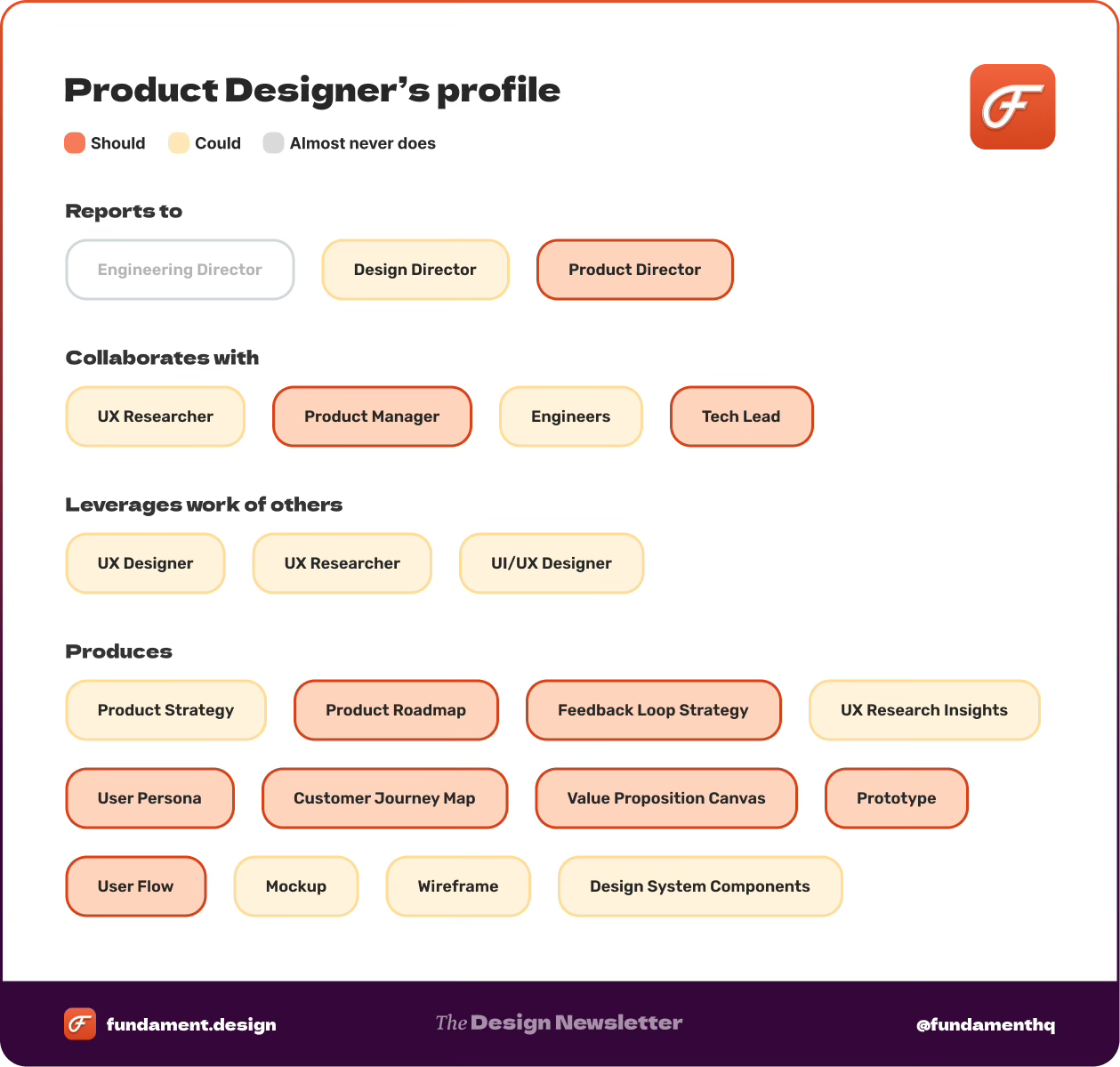
As you probably noticed, a Product Designer is focused on more than just the User Interface or the User Experience but the product as a whole. Their job is to make sure the product is usable, easy to use, and actually used. This function requires something else than graphic design skills or the knowledge to conduct user research. To be a good Product Designer, you must understand your product's niche and know how to influence the market.
Some could think that a Product Designer does this, plus all that a typical UX Designer and UI/UX Designer does. It's only accurate if you think of a start-up environment. In more mature organizations, Product Designers cooperate with UX Designers and UI/UX designers in the discovery and delivery phases, respectively.
Product-based vs. Project-based work
I'm aware that some might not particularly like how I described these three roles and would prefer to define product work differently. Here's an alternative if you are one of them.
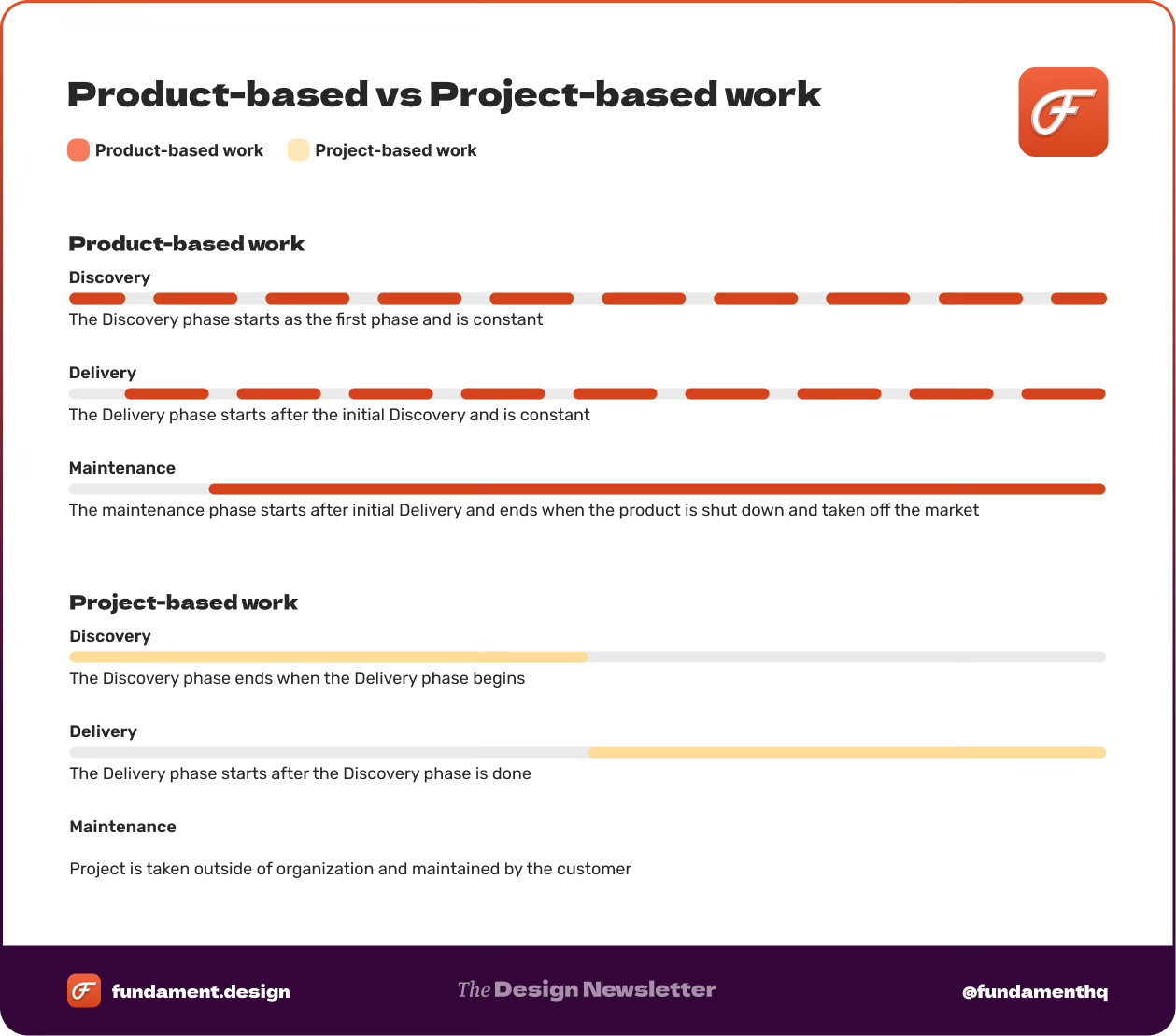
Think of a product in terms of when the Designer's and Engineering Team's job ends. If this work stops after releasing a product version or just a specific functionality, and there's no maintenance or constant improvements, it's not the product design. It sounds like a software house or an agency environment where a customer needs to develop an MVP, and after releasing it, they take the project away and are gone. The Designer and the entire Engineering Team have literally no chance to validate and improve on what they initially built.
Summary
I outlined how these three roles are different in a way that is clear and easy to comprehend, especially if you are a newcomer to the field. My goal was not to convince you to update your org tree and make your UI/UX Designers report to an Engineering Manager. It also wasn’t to update your LinkedIn title right after reading it. What I wanted to emphasize is that we should be more careful in naming the roles of ourselves and other designers in our organizations. A Product Designer is not the same as a UI/UX Designer or a UX Designer.
Most importantly, it doesn't mean some roles should be less respected, but I still observe such behavior in online discussions. Let's stop maniacally expressing that UI is not UX and respect each other's work more. Of course, UI and UX are different terms, but no one can fully separate them. User Interface is a part of the overall User Experience and tremendously influences it.
If you enjoyed this content, we’d appreciate your help by sharing our newsletter with your designer friends!